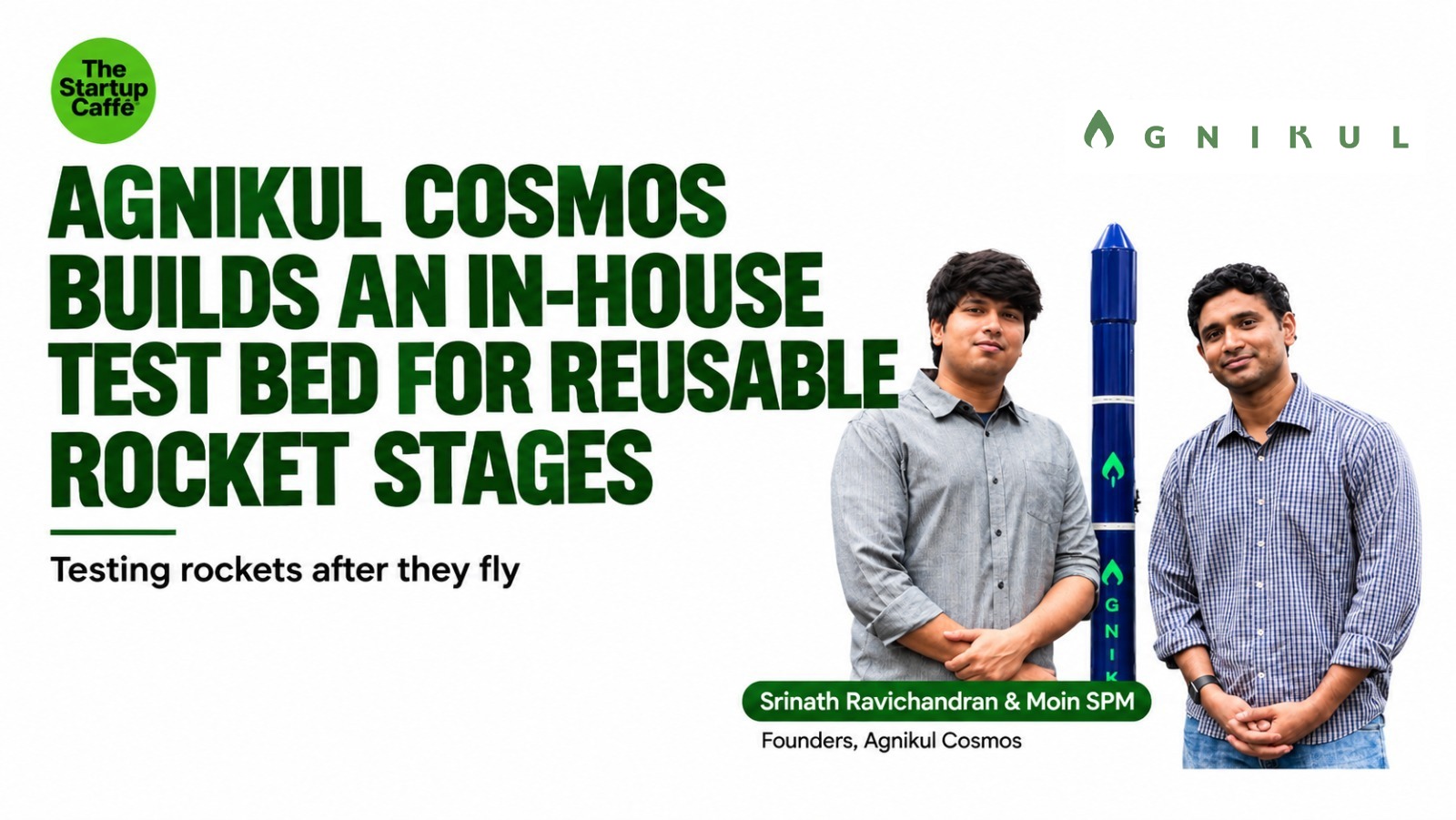
India’s private space sector is moving beyond building rockets that fly once. Chennai-based space startup Agnikul Cosmos has inaugurated new facilities designed to test complete rocket stages under flight-like conditions and inspect recovered stages for future missions.
The development marks an important step in the company’s ambition to make reusable launch vehicles a practical part of India’s growing space economy. Rather than focusing only on the launch itself, Agnikul is building the infrastructure needed to test, recover, inspect and prepare rocket stages for another flight.
A Facility Built Around Reusability
The new Stage Testing & Inspection Facility (STIF) is designed to test complete rocket stages with propulsion and avionics integrated.
The facility supports thrust levels ranging from 1 kN to 200 kN, liquid oxygen sub-cooling down to 73 K and full-duration burns of up to 150 seconds. These capabilities allow the company to evaluate rocket stages in conditions intended to replicate important aspects of their missions.
The facility will also support post-flight inspection and requalification of recovered stages. This is particularly important because a reusable rocket must be shown to remain safe and reliable after experiencing the stresses of launch and return.
From One Flight to Multiple Missions
Traditional launch vehicles are generally designed for a single mission, making the manufacturing and replacement of major components a recurring cost.
Reusable rockets aim to change that model by allowing expensive stages to fly multiple times. However, reusability requires more than a vehicle capable of returning to Earth. Companies must also develop reliable systems for inspection, testing, refurbishment and requalification.
Agnikul’s new infrastructure is intended to support a repeatable build, test, fly, recover, inspect, requalify and fly-again cycle. The company says this capability will be important as it works towards its second mission.
Manufacturing Critical Components In-House
Alongside STIF, Agnikul has opened the Pressurant Tank Realisation, Over-wrapping and Outfitting Facility (PROOF).
The facility is designed for in-house manufacturing of pressure vessels, which store gases or liquids at pressures significantly different from the surrounding environment.
PROOF can produce more than 10 vessels a month, including vessels with capacities of up to 3,500 litres and pressure ratings of 350 bar. Developing this capability internally could help the company strengthen control over critical launch-vehicle components and manufacturing processes.
The Startup Behind Agnibaan
Founded in 2017 by Srinath Ravichandran and Moin SPM, Agnikul Cosmos is headquartered in Chennai and incubated at IIT Madras.
The startup develops the Agnibaan family of configurable small-lift launch vehicles. It has also developed single-piece, 3D-printed semi-cryogenic rocket engines, which form an important part of its launch-vehicle technology.
In May 2024, Agnikul conducted Mission 01, Agnibaan SOrTeD, from its privately built launchpad at Sriharikota. The mission was an important demonstration of the company’s launch capabilities.
Why This Matters for India’s Space Industry
India’s private space ecosystem is expanding rapidly, with startups working across launch vehicles, satellites, propulsion, Earth observation and other space technologies.
Agnikul’s new facilities highlight a particularly important part of that growth: building the infrastructure required to develop and operate advanced launch systems repeatedly.
If reusable rocket technology becomes commercially viable, it could help reduce launch costs, improve mission flexibility and support more frequent access to space.
For Agnikul, the next challenge is to turn its testing and manufacturing capabilities into reliable flight operations. For India’s space sector, the development represents another step towards building a competitive launch industry with more advanced domestic capabilities.
Featured to The Startup Caffe
The Startup Caffe brings you the latest stories shaping India’s startup, deep-tech and innovation ecosystem.
Stay connected with us for more insights on founders, emerging businesses, space technology, advanced manufacturing and the companies building India’s future.