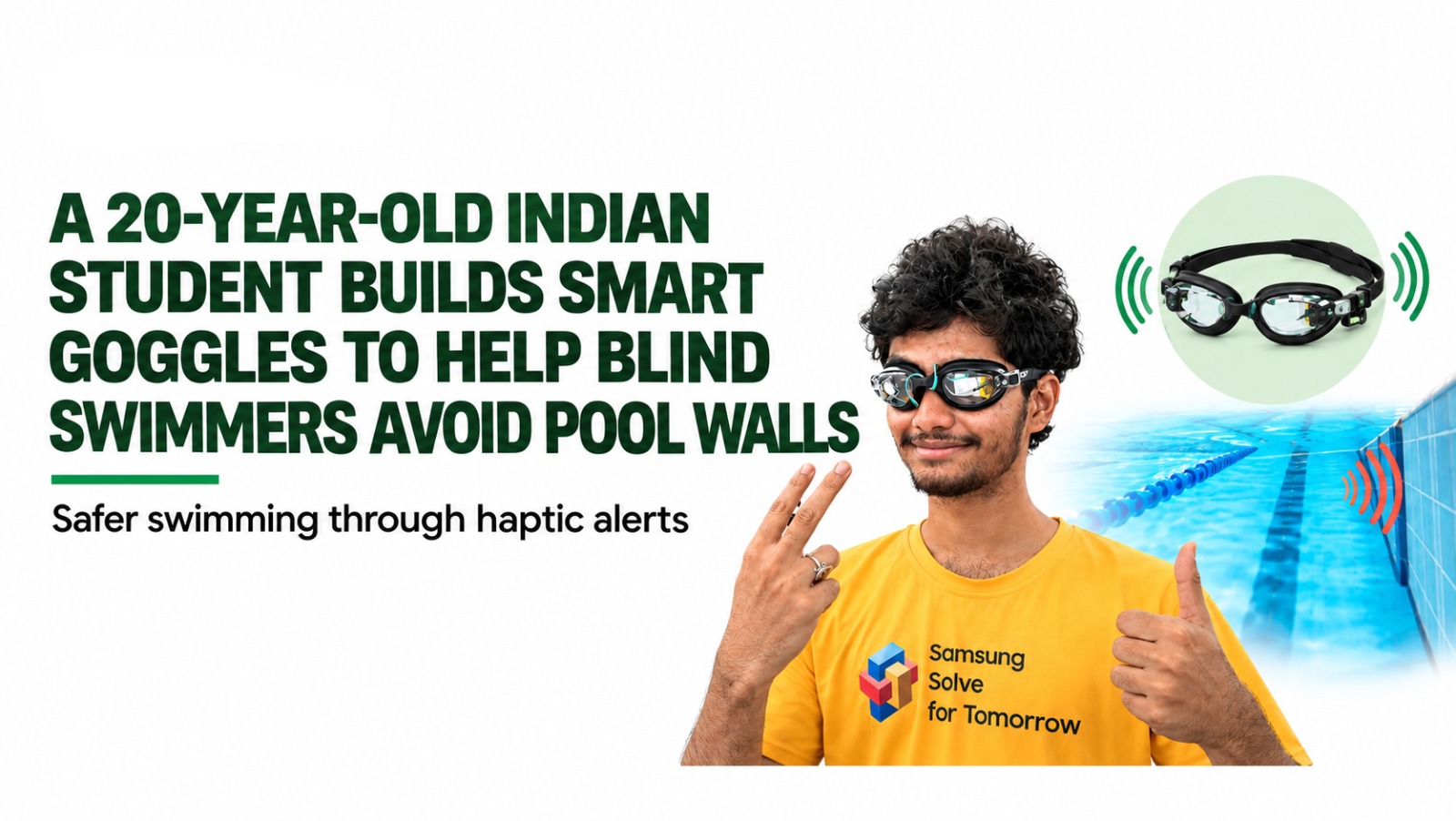
A swimming pool can be an intimidating place for visually impaired athletes, particularly when they cannot easily judge how close they are to the wall at the end of a lane. Pasupuleti Ruthvik, a 20-year-old engineering student from Chittoor, Andhra Pradesh, is working to address this challenge with Untethered, a pair of smart swimming goggles designed to warn swimmers when a pool wall is approaching.
Inspired by an accident involving a friend, Ruthvik developed a prototype that combines ultrasonic sensors with haptic feedback to provide physical alerts underwater. His innovation has earned a place among the Top 20 teams of Samsung Solve for Tomorrow 2026, bringing attention to an assistive technology project focused on making swimming safer and more independent.
A Personal Experience Sparked the Idea
Ruthvik's journey began with a concern about preventing injuries and helping people participate in activities with greater confidence.
An accident in which his friend suffered a concussion made him think about how technology could reduce risks in everyday situations. His interest in swimming, combined with his growing ambition to become an entrepreneur, eventually led him to explore a solution for visually impaired swimmers.
Rather than developing another conventional swimming accessory, he focused on a specific problem: how could a swimmer know when the pool wall was getting close without relying entirely on another person's guidance?
That question became the starting point for Untethered.
How Untethered Smart Goggles Work
The prototype uses ultrasonic sensing to estimate the swimmer's distance from the approaching pool wall. As the swimmer moves closer, the system delivers a haptic alert, allowing the user to receive a physical warning rather than depending on visual information or an audible signal.
This approach could help swimmers anticipate the end of a lane and prepare to turn or stop, potentially reducing accidental collisions.
The concept is particularly relevant in swimming environments, where ordinary navigation aids may be difficult to use. By integrating sensing and feedback into a wearable device, Ruthvik aims to make the technology practical for use during training.
However, Untethered remains a developing innovation, and its real-world effectiveness will depend on further testing, user feedback and refinement of the prototype.
From an Engineering Project to a Real-World Product
Ruthvik's participation in Samsung Solve for Tomorrow 2026 has helped him look beyond whether the technology works and consider how people will actually use it.
During the programme's prototyping bootcamp, mentorship encouraged him to think about user needs, comfort, practical usability and the challenges of turning an engineering idea into a product.
For assistive technology, these considerations are especially important. The goggles must be comfortable during swimming, provide timely and reliable alerts, and work under changing pool conditions. Feedback from visually impaired swimmers could be essential in shaping future versions.
Ruthvik's ambition is to develop Untethered beyond a laboratory prototype into an affordable, scalable solution that can support swimmers in India and potentially other countries.
A Place Among India's Young Innovators
Untethered's selection among the Top 20 teams of Samsung Solve for Tomorrow 2026 gives the project an opportunity to progress through mentorship and further development.
The national programme encourages young people to use science, technology, engineering and mathematics to address real-world challenges. Its 2026 finalists include innovators working on accessibility, healthcare, environmental sustainability, education and sports technology.
Ruthvik's project stands out for applying relatively compact sensing technology to a specific challenge faced by visually impaired athletes. It also highlights how innovation can emerge from smaller cities such as Chittoor, rather than only from established technology hubs.
Making Swimming More Inclusive
Untethered represents a broader opportunity for assistive technology: helping people participate in activities with greater independence, rather than simply adapting to existing limitations.
If further development and testing prove successful, smart goggles like these could become a useful tool for visually impaired swimmers and their coaches.
For Ruthvik, the goal is not just to build a clever engineering prototype. It is to create technology that gives swimmers more confidence in the water.
Sometimes, a meaningful innovation begins with a simple question: what if a small device could help someone do something they love more safely?
Featured to The Startup Caffe
The Startup Caffe brings you the latest stories shaping India's startup, deep-tech and innovation ecosystem.
Stay connected with us for more insights on young founders, assistive technology, unique products and the innovators building solutions for a more inclusive future.