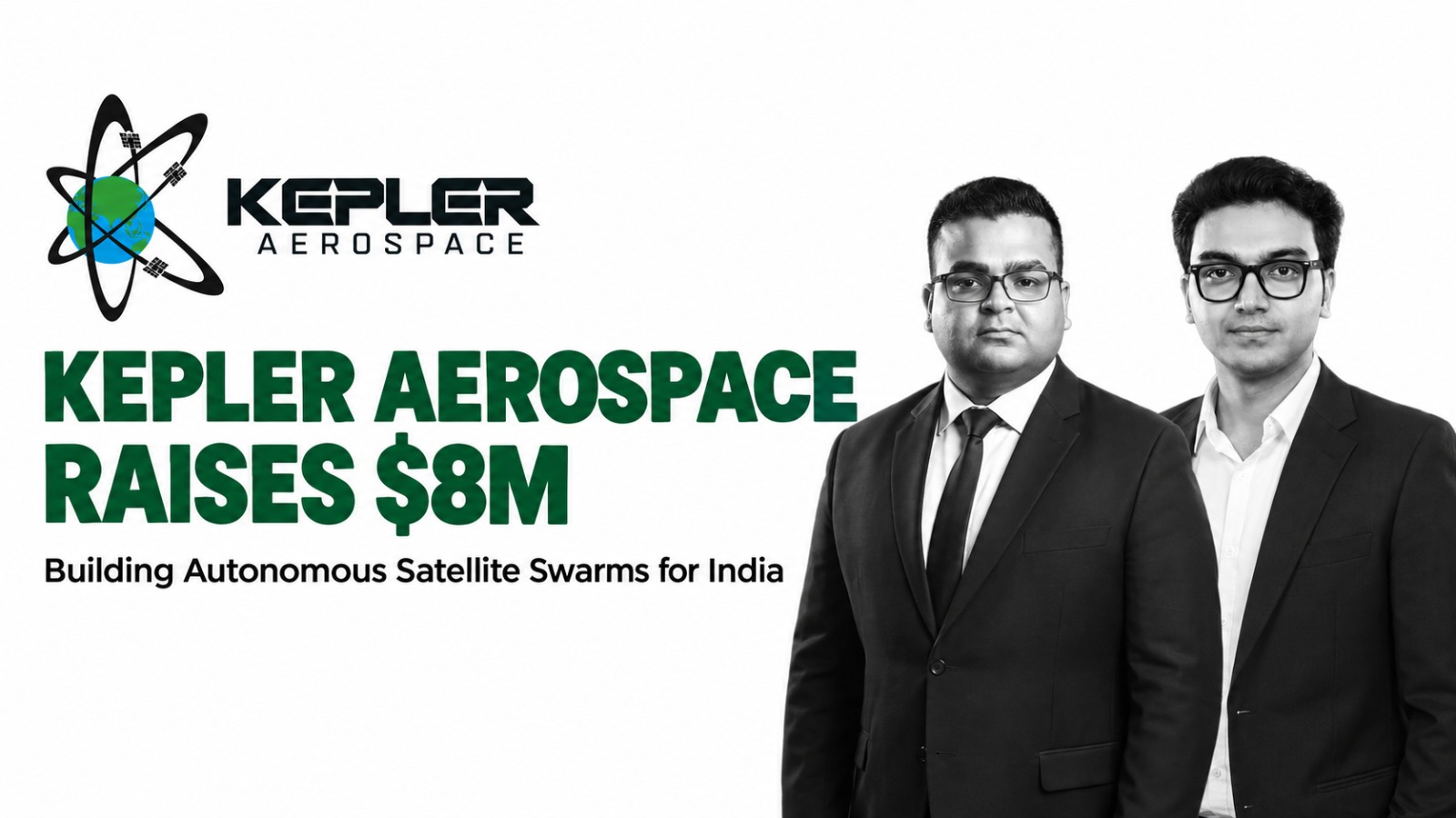
Bengaluru-based space infrastructure startup Kepler Aerospace has raised $8 million in its first external funding round, marking a major step towards building autonomous satellite constellations for India’s defence and space ecosystem. The seed round was led by Blue Ashva Capital and co-led by Finvolve India Accelerator, with the fresh capital set to accelerate the company’s swarming Intelligence, Surveillance and Reconnaissance (ISR) capabilities.
Founded in 2018, Kepler has spent years building space and mission-operations infrastructure before turning to external capital.
Six Swarming Satellites to Lead the Next Phase
A key priority for Kepler is the deployment of its first six swarming ISR satellites under two IDEX prime contracts secured by the company. The programmes are backed by approximately $4 million in IDEX grants.
Unlike conventional satellite systems that can depend heavily on ground stations for instructions, Kepler’s proposed swarming architecture is designed to allow satellites to communicate with one another, coordinate tasks and operate more autonomously in orbit.
The objective is to create persistent intelligence capabilities that can reduce the time between collecting information and delivering actionable intelligence.
Building a Complete Space Infrastructure Stack
Kepler’s ambitions extend beyond satellites. The company brings together satellite systems, avionics, ground infrastructure, mission operations and intelligence platforms into a single ecosystem.
Its Mission Operations as a Service platform serves a large portion of India’s space industry and acts as the primary mission operator for several ISRO satellites.
The company also operates a network of more than 70 ground stations, providing capabilities covering satellite communication, tracking, telemetry, command and mission operations.
From Months to Minutes
Kepler says its integrated approach is designed to reduce intelligence latency from months to minutes.
For defence and national-security applications, faster access to information can significantly influence how quickly situations are detected, assessed and responded to. Persistent ISR systems could therefore provide continuous monitoring rather than relying solely on periodic satellite observations.
The company sees autonomous satellite swarms as an important part of this shift, with multiple satellites working together rather than functioning as isolated assets.
Funding to Accelerate Defence-Space Capabilities
Kepler plans to deploy its first six swarming ISR satellites over the next 12–24 months. It will simultaneously scale its mission-operations and avionics-as-a-service businesses and strengthen its engineering capabilities.
The startup is also moving into a new facility and plans to add around 40 employees to its existing team.
The investment comes as India increasingly focuses on building indigenous capabilities across space, defence and advanced technology. Kepler’s approach reflects this transition from individual space hardware towards integrated, software-driven systems capable of delivering real-time intelligence.
Building India’s Autonomous Space Future
With its combination of satellite technology, avionics, ground infrastructure and mission operations, Kepler Aerospace is positioning itself as more than a satellite developer.
Its next challenge will be moving from contracts and technology development to reliable deployment at scale. If successful, autonomous satellite swarms could become an important component of India’s future defence and space infrastructure.
Featured by The Startup Caffe
The Startup Caffe brings you the latest stories from India’s space, defence and deep-tech startup ecosystem.
Stay connected for breakthrough innovations, ambitious founders and technologies shaping India’s future.