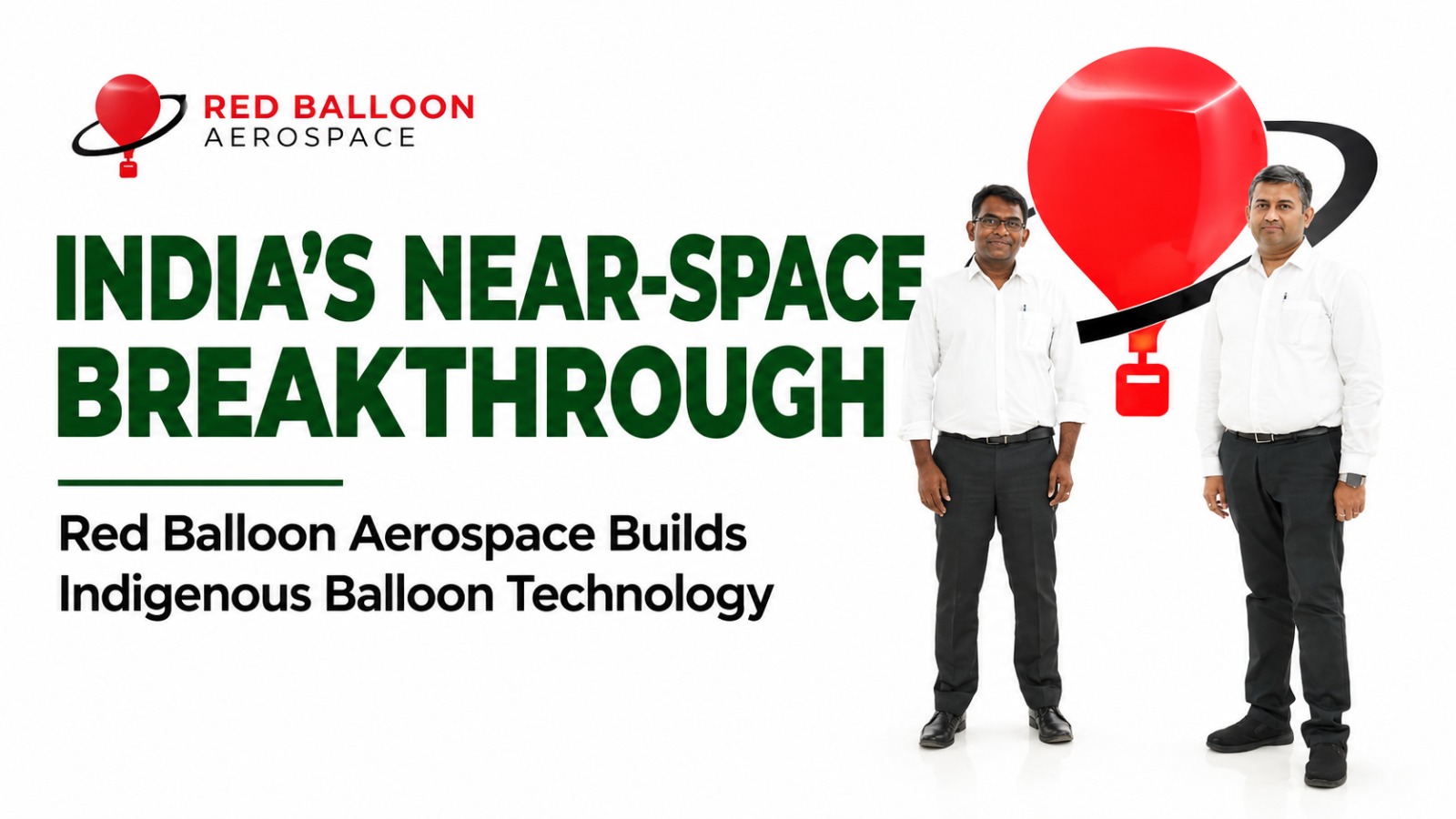
India’s deep-tech ecosystem is reaching beyond traditional aircraft and satellites, with Andhra Pradesh-based Red Balloon Aerospace (RBA) developing platforms designed to operate in the largely unexplored region between the atmosphere and space. The startup is building lighter-than-air systems for communication, surveillance, scientific research, environmental monitoring and disaster management.
Founded in May 2025 by Dr Chakravadhanula Venkata Sai Kiran and Sireesh Pallikonda, RBA is focused on creating near-space infrastructure that can operate at altitudes of around 20 to 50 kilometres.
India’s First Super-Pressure Balloon Takes Flight
A major milestone came on March 27, 2026, when Red Balloon Aerospace launched what it describes as India’s first super-pressure balloon through Mission SANA.
Its VISTA super-pressure balloon platform has already completed commercial flights, carrying payloads for aerospace partners. The platform allows customers to send sensors, communication equipment and technology demonstrators into near-space through dedicated or rideshare missions.
Three Platforms for Different Missions
RBA is developing three major platforms: HELIX, ALTIS and VISTA.
VISTA focuses on near-space balloon missions, while ALTIS is being developed as a tethered aerostat system. HELIX is the company’s long-endurance stratospheric airship, designed for applications including telecommunications and cargo.
The initial HELIX platform is targeted for completion by December 2026, with flight trials expected to begin in early 2027. ALTIS and a subscale version of HELIX are also part of the company’s upcoming plans.
Bridging the Gap Between Aircraft and Satellites
The startup sees a significant opportunity in the region between conventional aircraft and satellites. While aircraft and drones generally operate at lower altitudes, satellites function hundreds of kilometres above Earth.
RBA aims to use this intermediate space for persistent communication and observation. Its platforms are designed to remain at stable altitudes for extended periods and can carry payloads ranging from 50 kilograms to 20 tonnes, depending on mission requirements.
Indigenous Technology at the Core
The company says it handles most of its design, development and manufacturing in-house. Around 80–90% of its overall system is indigenous, although certain specialised electronic components are still imported.
RBA has also developed proprietary multi-layered nanocomposite materials designed to withstand harsh environmental conditions while retaining hydrogen for extended periods. These materials form the foundation of its lighter-than-air platforms and are protected through provisional patents.
A New Approach to Connectivity
One of the startup’s biggest ambitions is to provide connectivity to remote and underserved regions where installing fibre networks or cellular towers can be expensive.
According to the company, a near-space platform operating around 20 kilometres above the Earth could potentially provide coverage equivalent to hundreds of traditional cell towers. RBA claims its systems can deliver speeds of up to 500 Mbps with latency as low as 0.3 milliseconds.
Unlike conventional satellites, its reusable platforms can potentially be recovered, upgraded and redeployed, reducing replacement costs and environmental impact.
Scaling From Vijayawada
RBA currently operates from a 20,000-square-foot facility in Vijayawada and has around 24 employees. The startup plans to expand its workforce to nearly 150 people over the coming year as it moves towards larger-scale development and commercial deployment.
Featured by The Startup Caffe
The Startup Caffe brings you stories of Indian deep-tech startups pushing the boundaries of innovation.
Stay connected for more breakthrough technologies, ambitious founders and businesses building India’s future.
The acquisition brings the rapidly growing AI coding platform into SpaceX’s technology ecosystem and highlights the rising value of artificial intelligence tools that are changing how software is developed.
Who Is Aman Sanger?
Sanger is the co-founder and Chief Operating Officer of Anysphere, the company behind Cursor. He studied at MIT, where he met his fellow co-founders and began exploring opportunities around artificial intelligence.
Before building Anysphere, Sanger worked at companies including Google and Bridgewater Associates and also explored AI consulting. His experience across technology and business eventually led him towards entrepreneurship.
At Anysphere, Sanger has played a key role in the company’s operational and business activities as Cursor expanded its presence among developers.
How Cursor Started
Anysphere was founded in 2022 by four co-founders who initially experimented with different applications of AI, including computer-aided design.
The team eventually focused on a common challenge faced by software developers: using AI assistance often required switching between coding environments and separate chatbot applications.
Cursor was created to bring AI directly into the coding workflow. Instead of simply providing basic code suggestions, the platform enables developers to interact with their codebase using natural-language instructions.
What Makes Cursor Different?
Cursor is designed to help developers generate and edit code, identify bugs, explain existing code and make changes across multiple files.
Its natural-language interface has also contributed to the popularity of what is commonly called “vibe coding”—a style of software development where users describe what they want to create and AI handles a significant portion of the implementation.
The rise of such tools reflects a broader shift towards AI-assisted software development, where developers increasingly collaborate with AI systems rather than relying solely on traditional coding methods.
Why SpaceX Acquired Anysphere
SpaceX and Cursor reportedly began collaborating on AI model training in April 2026. The partnership focused on computing and model-training capabilities required for advanced AI coding systems.
SpaceX subsequently acquired Anysphere in an all-stock transaction with an implied value of $60 billion, with the acquisition becoming effective on August 14, 2026.
The deal gives SpaceX access to Cursor’s technology and the team behind it, while Anysphere gains access to the larger computing and AI ecosystem surrounding Musk’s technology ventures.
What Comes Next for Cursor?
Following the acquisition, Anysphere became a wholly owned subsidiary of SpaceX, while Cursor continues as an AI coding platform.
For Sanger and his co-founders, the deal represents a remarkable journey from an MIT-based idea to a major technology business. It also signals how quickly AI coding has moved from an emerging concept to a strategic technology category attracting some of the world’s biggest companies.
As AI becomes increasingly capable of building and modifying software, Cursor’s integration with SpaceX could become an important chapter in the evolution of AI-assisted development.
Featured by The Startup Caffe
The Startup Caffe brings you the latest stories from the world of startups, AI and technology.
Stay connected for inspiring founders, breakthrough innovations and the deals shaping the future of business.