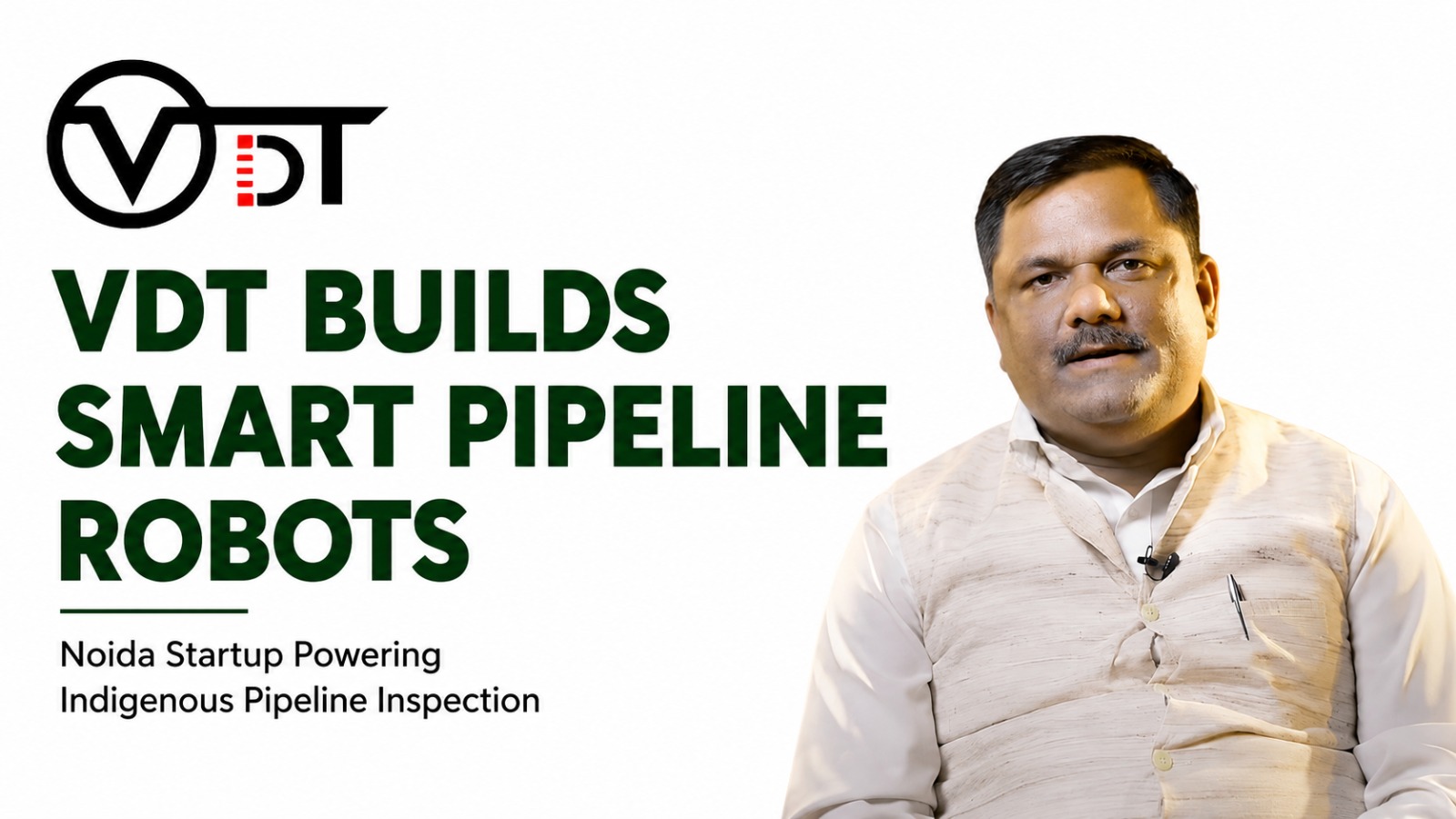
Deep beneath India’s roads, cities and industrial zones, thousands of kilometres of pipelines transport oil, gas and other critical products. But inspecting these pipelines is a complex challenge. Noida-based VDT Pipeline Integrity Solutions is addressing this problem with specialised robotic inspection tools that travel inside pipelines to identify dents, corrosion and other potentially dangerous flaws.
Founded in 2017, the company is working to build inspection technology in India for a sector that has traditionally depended heavily on imported equipment and services.
Turning Pipeline Inspection Into an Engineering Mission
Pipelines can extend for hundreds of kilometres underground or underwater, making conventional visual inspection nearly impossible. Instead, operators use machines commonly known as “pigs” that travel through the inside of pipelines, collecting information about their condition.
VDT has developed tools designed to perform this critical inspection. Its geometry inspection technology measures the internal shape of pipelines, helping identify issues such as dents and changes in the pipe’s roundness.
The company has also developed a magnetic flux leakage (MFL) inspection tool, which uses magnetic fields to detect areas where metal has been lost, particularly because of corrosion.
Building Indigenous Technology for Oil and Gas
VDT Pipeline Integrity Solutions was established in Noida on August 31, 2017, and is led by founder and Managing Director Bhuvanesh Sharma.
The company says its team developed India’s first patented geometry inspection tool and subsequently expanded its technology portfolio with magnetic flux leakage inspection.
Its work is supported through initiatives including the ONGC Start-up Fund and Startup India, while it has also received seed support from IIM Lucknow’s Enterprise Incubation Centre.
More Than Just Inspection Robots
VDT’s business extends beyond the machines themselves. The company offers a broader range of pipeline integrity and engineering services, including intelligent pigging, baseline surveys and asset integrity management.
It also works in specialised areas such as hot tapping, which enables connections to be made on operational pipelines without shutting down the entire system.
Additional services include risk-based inspection, metal magnetic memory testing, acoustic inspection and machining capabilities.
This integrated approach allows pipeline operators to hire VDT not simply for equipment, but for an end-to-end inspection process that can include running the tool, collecting data and helping determine which sections require attention.
Why Domestic Pipeline Technology Matters
India has a vast and expanding network of oil, gas and product pipelines. Traditionally, sophisticated inspection equipment has often been sourced from international companies.
Domestic development could help reduce dependence on imported technology while potentially improving flexibility around inspection schedules, service availability and costs.
For VDT, the opportunity lies in combining engineering expertise with a growing infrastructure market. As India’s energy network expands, technologies capable of detecting problems before they become major failures could become increasingly important.
Featured by The Startup Caffe
The Startup Caffe highlights innovative Indian startups solving real-world industrial challenges.
Stay connected for more stories on deep tech, engineering innovation and businesses building for India’s future.