
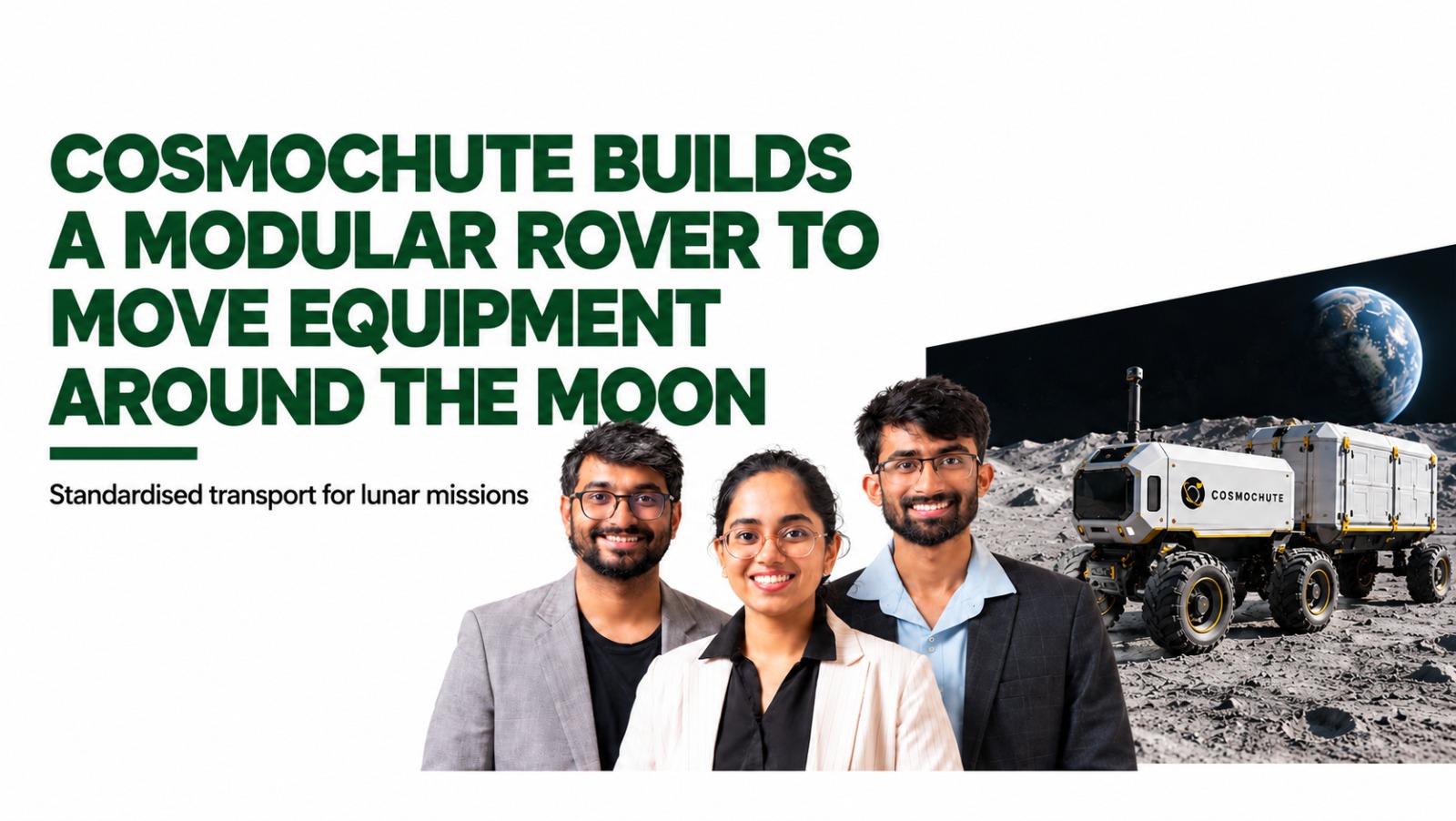
Getting equipment to the Moon is only part of the challenge. Once it reaches the lunar surface, scientific instruments, experiments and other payloads still need to be transported and deployed at their intended destinations. Ahmedabad-based space startup Cosmochute is developing a modular mobility platform designed to make that process simpler and more repeatable.
Founded in 2026 by Janhavi Gore, Amit Chowdhary and Dhruv Alok Sangal, the company is building LEAP, a lunar transportation system combining a rover and trailer with standardised payload bays. Its objective is to reduce the need to engineer a completely different mobility system for every lunar mission.
A Rover Designed to Carry Different Payloads
Cosmochute's LEAP programme focuses on a practical problem in lunar exploration: moving equipment across the Moon's surface.
Space missions often involve specialised instruments, scientific experiments and technology demonstrations, each with different transportation and deployment requirements. Designing a dedicated mobility solution for every payload can add engineering complexity, cost and time.
Cosmochute wants to change this approach by developing a common platform that can accommodate different payloads.
Its system combines a modular rover with a trailer, allowing equipment to be transported and deployed through a shared architecture. Standardised payload bays are intended to make integration easier and reduce the amount of mission-specific engineering required.
The broader vision is to develop reusable infrastructure that can support multiple lunar missions rather than treating every deployment as an entirely separate project.
Why Standardisation Matters on the Moon
Lunar missions operate under demanding conditions, including extreme temperatures, difficult terrain and limited opportunities for repair or resupply.
Every additional custom-built system can introduce new technical challenges and increase the complexity of mission planning.
A standardised mobility platform could help mission operators transport equipment using an established system instead of developing new transportation hardware for each requirement.
For scientific missions, this could support the movement of research instruments and other payloads. For future commercial lunar activities, reliable transportation and deployment infrastructure may become increasingly important as more organisations seek to conduct operations beyond Earth.
Cosmochute is positioning its technology as a potential building block for this emerging lunar economy.
$1.5 Million to Develop Lunar Mobility Technology
In October 2026, Cosmochute announced a $1.5 million pre-seed funding round led by Accel and Prosus Ventures through the Atoms X programme.
The round also included participation from IIMA Ventures' Deep-tech and Aerospace Acceleration Fund, Operators Studio and Chinmayi Muthyala.
The company plans to use the capital to advance LEAP's development, expand its engineering team and move forward with its commercial roadmap.
It is also establishing lunar laboratories at IIMA Ventures' incubation facility to support its research and development work.
Building Infrastructure for Future Lunar Missions
Cosmochute's founding team brings together aerospace engineering and robotics expertise, with a focus on developing systems for sustained operations beyond Earth.
The company is also receiving guidance from Dr. Mylswamy Annadurai, former programme director of Chandrayaan-1, as it develops its lunar mobility capabilities.
Its long-term ambition extends beyond building a single rover. Cosmochute wants to develop infrastructure that can support transportation, payload deployment and other activities needed for future scientific and commercial missions on the Moon.
The technology is still under development, and its eventual impact will depend on engineering progress, mission partnerships and successful deployment.
But the idea addresses an important question for the future of space exploration: once humans and machines reach the Moon, how will they move the equipment needed to work there?
Cosmochute is betting that a reusable, standardised transport system could become part of the answer.
Featured to The Startup Caffe
The Startup Caffe brings you the latest stories shaping India's startup, space technology and innovation ecosystem.
Stay connected with us for more insights on founders, emerging businesses, lunar exploration, deeptech and the companies building India's future.